Short answer
A lobster back bend is laid out by parallel-line development: each segment is a cylinder cut at both ends by a plane. With R the centre-line radius, r the pipe's mean radius and θ the whole segment angle, a half segment's line at angle φ is (R − r · cos φ) · tan(θ / 2) long; a whole segment is twice that.
A lobster back bend, also called a segmented, mitered or gored elbow, turns a round pipe or duct with short straight segments instead of one smooth bend. It is the elbow of ventilation, dust extraction, exhaust and large-diameter pipe, because every piece is a simple cylinder that can be rolled from a flat strip.
The video walks through the whole job in two minutes, from the sizes to the DXF:
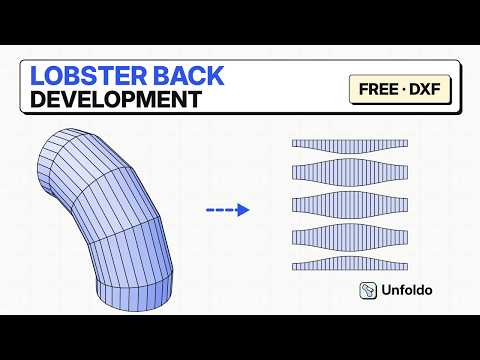
The segments and their angles
A 90° lobster back with 5 segments has 3 whole segments in the middle and a half segment at each end. The half ends make the bend start and finish square to the straight pipe, so the two halves count as one whole: 5 segments give 4 whole-segment equivalents.
| Bend | Segments | Whole segment angle θ | Half segment angle |
|---|---|---|---|
| 90° | 3 (1 whole, 2 half) | 45° | 22.5° |
| 90° | 4 (2 whole, 2 half) | 30° | 15° |
| 90° | 5 (3 whole, 2 half) | 22.5° | 11.25° |
| 90° | 6 (4 whole, 2 half) | 18° | 9° |
| 45° | 3 (1 whole, 2 half) | 22.5° | 11.25° |
In general, θ = bend angle / (n − 1), where n is the number of segments, the halves included. Each joint between two segments is cut at θ / 2 from square, so every cut in the bend is the same and one template marks them all.
The flat pattern of a segment
Unrolled, each segment is a strip as long as the pipe's girth, π times the mean diameter, with a curved edge at each cut. The width of the strip at any point round the pipe is the length of the line on the pipe's surface between the two cuts.
Measure the angle φ round the pipe from the throat, the inside of the bend. A line at φ sits at a distance R − r · cos φ from the bend's centre, so the cut plane, tilted at θ / 2, gives it a length of (R − r · cos φ) · tan(θ / 2) on a half segment, and twice that on a whole segment, which is cut at both ends.
- Work out θ. Bend angle divided by the number of segments less one.
- Divide the girth. Draw a line π × D long (the mean diameter) and divide it into 12 or more equal parts, each standing for an angle φ round the pipe.
- Set up the ordinates. At each division, square up the length of the line at that φ from the formula: shortest at the throat, longest at the heel.
- Draw the cut. Join the tops of the ordinates with a smooth curve. That is a half segment; mirror it about the base line for a whole one.
- Add the seam. Decide where the seam of this segment goes (throat, heel or side) and start the girth line there.
A worked example
Take a 90° bend in 500 mm duct, with a centre-line radius R = 750 mm (1.5 × D) and 5 segments, thin sheet. Then θ = 90° / 4 = 22.5°, the cut is at 11.25° from square, tan 11.25° = 0.19891 and the mean radius r is 250 mm. The girth of every strip is π × 500 = 1570.80 mm.
| Angle round the pipe φ | Where | Half segment | Whole segment |
|---|---|---|---|
| 0° | Throat (inside of the bend) | 99.46 mm | 198.91 mm |
| 30° | 106.12 mm | 212.24 mm | |
| 60° | 124.32 mm | 248.64 mm | |
| 90° | Side (on the centre line) | 149.18 mm | 298.37 mm |
| 120° | 174.05 mm | 348.10 mm | |
| 150° | 192.25 mm | 384.50 mm | |
| 180° | Heel (outside of the bend) | 198.91 mm | 397.82 mm |
The side line of a whole segment, 298.37 mm, is the centre line's own length between the cuts: 2 × R × tan(θ / 2) = 2 × 750 × 0.19891.
The same bend in 3 mm sheet with the 500 mm as an inside size, worked out by Unfoldo. Change the sizes on the part to see the strips follow:
| Diameter (mean) | 503 mm |
|---|---|
| Segments | 5 (3 full, 2 half) |
| Segment angle | 22.5° (ends 11.25°) |
| Pattern size | 1,580.22 × 1,193.47 mm |
| Press lines | 115 |
| Parts | 5 |
Seams: staggered or in line
Where the seam of each segment goes changes both the bend and the sheet.
- Staggered, inside and outside: the seam of each segment sits opposite the one before. The welds never line up and the bend is stiffer. The strips do not nest as well.
- In line, all on one side: every seam is on the same line. The strips fit into each other's curves on the sheet, so a whole bend can come from one strip of material.
- On the sides: the seams sit at 90° round the pipe, away from the throat and the heel, where the cut edges are the most tilted.
Unfoldo offers seven seam layouts, two seams per segment among them, for parts too large for one sheet width.
Thickness, radius and other kinds
On plate, the pattern is worked out on the mean line: an inside diameter plus one thickness, an outside diameter minus one. The centre-line radius does not change, but the girth and every ordinate do. The article on sheet thickness in flat patterns goes through why.
A tighter radius makes the throat ordinates short; below about R = D the throat lines of a whole segment get very short and the cuts hard to weld. A bend at any angle, an extended bend with straight pipe at the ends, an oval duct and a tapered bend, where each segment is a short cone, are laid out the same way; the tapered one by radial-line development, like a truncated cone.
Questions
What is a lobster back bend?
A pipe or duct elbow made of short cylindrical segments welded together, also called a segmented, mitered or gored elbow. The two end segments are usually half segments, so the bend starts and ends square to the straight pipe.
How do I work out the segment angle?
Count the two half end segments as one whole: with n segments in total there are n − 1 whole-segment equivalents. The whole segment angle is the bend angle divided by n − 1, and each half segment gets half of that. A 90° bend in 5 segments has whole segments of 22.5° and half segments of 11.25°.
How long is each line of the pattern?
For a half segment, the length of the line at angle φ round the pipe is (R − r · cos φ) · tan(θ / 2), where R is the centre-line radius, r the mean radius of the pipe and θ the whole segment angle. A whole segment has twice that length. The girth of every strip is π times the mean diameter.
How many segments should a lobster back bend have?
More segments make a smoother bend with less pressure loss, but more cuts and welds. Ductwork often uses 3 to 5 segments for a 90° bend; larger and higher-pressure pipe more. The two half ends count among them.
Where should the seams go?
Staggering the seams inside and outside from one segment to the next keeps the welds from lining up and stiffens the bend. Putting them in line lets the strips nest on the sheet, which saves material when the patterns are cut from one sheet.
Does sheet thickness change the pattern?
Yes. The pattern is worked out on the mean line of the sheet: an inside diameter plus one thickness, or an outside diameter minus one. For 500 mm inside in 3 mm sheet, the girth of each strip is π × 503 = 1580.22 mm.