Z profile flat blank (press brake)
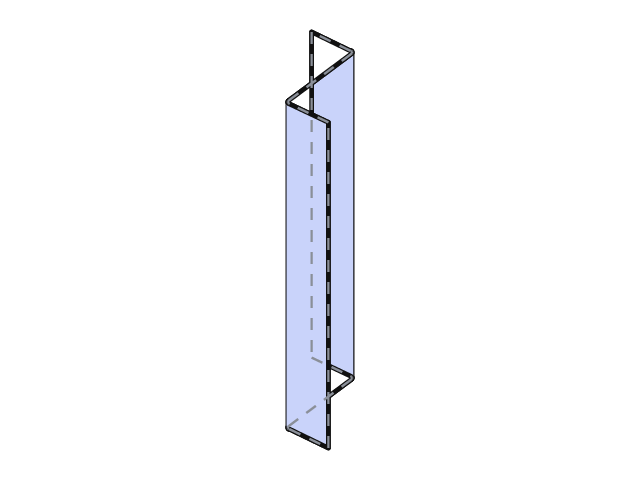
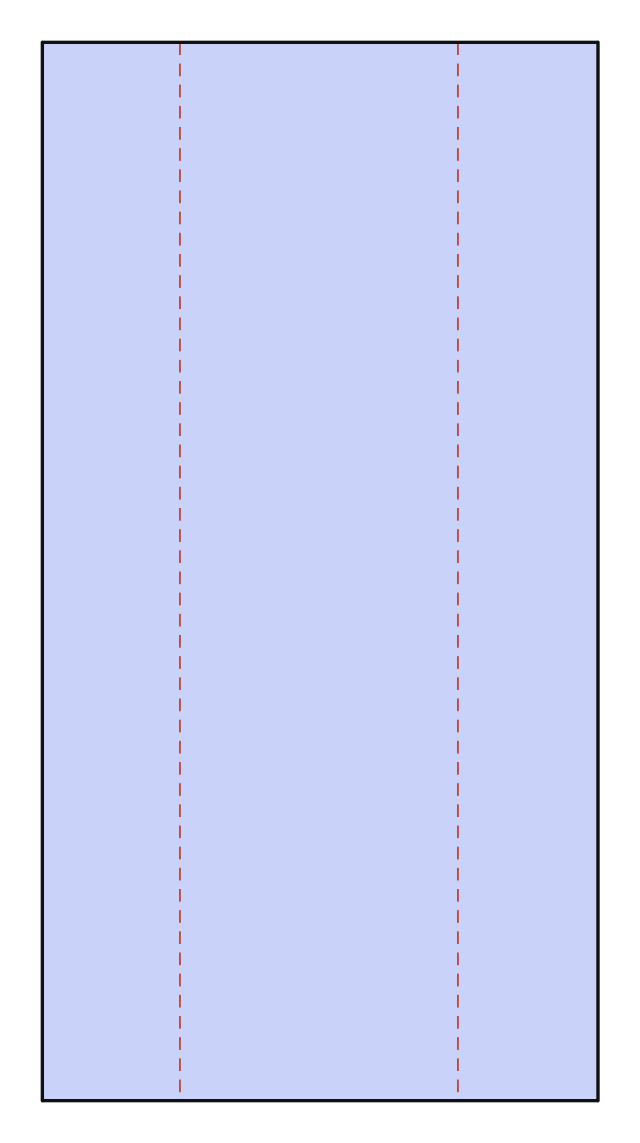
A profile bent twice in opposite directions, as a Z purlin or a step. Give the flanges, the web, the angle, the inside radius and the length; the bend lines are marked up and down for the press.
The flat blank of a bent Z profile: its width with the bend allowances, and the bend lines, up and down.
Sizes you enter
- Flange a (a): The first flange, along it, to the sharps, on the face chosen under Sheet (Outside: outer sizes, as a drawing gives them).
- Height b (b): Along the web: from the first bend's sharp to the second's, on the face chosen under Sheet (Outside: the overall height).
- Flange c (c): The second flange, along it, to the sharps, on the face chosen under Sheet (Outside: outer sizes, as a drawing gives them).
- Angle at flange a (A1): Between flange a and the web, once bent: 90 = square.
- Angle at flange c (A2): Between the web and flange c, once bent: 90 = square.
- Length (L): Along the bends.
- Inside radius (Ri): Of each bend, on the inside face. In air bending it follows the die: about a sixth of the V opening for mild steel.
- K factor (K): Where the neutral layer lies, as a part of the thickness from the inside face. 0: from DIN 6935 (from Ri and the thickness).
- Bend deduction (BD): Your own, from a test bend at this angle: what one bend takes off the sum of the outside legs. Given, it is used in place of K (only with the same angle at every bend). 0: not used.
What you get
The exact flat pattern of the part, worked out for the sheet thickness measured on the inside, the mean or the outside, with numbered press lines, the part in 3D, its weight and cutting length, and a DXF for laser, plasma or waterjet cutting (STEP as well).
How the pattern is developed
Bending on the press brake. A profile bent on a press brake is cut as one flat blank. Its width is the sum of the straight legs plus, at each bend, the length of the neutral layer through the bend: the angle turned times (Ri + K·t). K sets where the neutral layer lies; it follows DIN 6935 from the inside radius and the thickness unless the shop gives its own K, or its bend deduction from a test bend. Each bend line is drawn at the middle of its bend, marked up or down.
Where it is used
Angles, channels, Z purlins and hat sections bent on the press brake: brackets, frames, stiffeners, cable trays, cladding and roofing trims.
Worked example
Press brake profile, Z at Flange a 40 mm, Height b 80 mm, Flange c 40 mm, Angle at flange a 90°, Angle at flange c 90°, Length 300 mm, Inside radius 3 mm, K factor 0, Bend deduction 0 mm, sheet thickness 2 mm, legs measured outside, K from DIN 6935:
| Blank width | 151.74 mm |
|---|---|
| K factor, from DIN 6935 | 0.369 |
| Bend allowance, each bend | 5.87 mm |
| Setback, each side of a bend | 5 mm |
| Bend deduction, each bend | 4.13 mm |
| Bend lines from the first edge | 37.94 ↑ 90° R3, 113.81 ↓ 90° R3 |
| Pattern size | 151.74 × 300 mm |
| Area (bbox) | 0.0455 m² |
| Press lines | 2 |
| Parts | 1 |
Change any size on the page and the pattern, the press lines and these figures follow at once.
Questions
What sizes are needed to unfold a press brake profile, Z?
The flange a (a), height b (b), flange c (c), angle at flange a (A1), angle at flange c (A2), length (L), inside radius (Ri), k factor (K), bend deduction (BD), plus the sheet thickness and whether the sizes are measured on the inside, the mean surface or the outside. Unfoldo checks the sizes as they are typed and says which one does not make a part.
How big is the flat pattern of a press brake profile, Z?
It depends on the sizes. At Flange a 40 mm, Height b 80 mm, Flange c 40 mm, Angle at flange a 90°, Angle at flange c 90°, Length 300 mm, Inside radius 3 mm, K factor 0, Bend deduction 0 mm the pattern is 151.74 × 300 mm, in 1 part, with 2 press lines. Each pattern comes with its own size frame and area.
Does it allow for the sheet thickness?
Yes, and it has to: on a press brake the neutral layer moves toward the inside of the bend, so the mean surface is not the right length. Enter the thickness and say whether the legs are inside or outside sizes; the bend allowance follows from the inside radius and K (DIN 6935, your own K, or your bend deduction).
What files does Unfoldo give for a press brake profile, Z?
A DXF with true arcs for laser, plasma and waterjet cutting software (the cut profile on one layer, the press lines and their numbers on others), a STEP model of the part, and a PDF shop drawing with the sizes and the true lengths of the press lines.
How accurate is it?
Arcs in the DXF are true arcs, and curves that are not arcs stay within 0.005 mm of the exact curve.
Is it free?
The pattern can be seen and tried free, without an account. The exact DXF, STEP and the tables come with Pro ($29 a month), the team plan or a 30-day pass ($19); every new account gets 15 days of Pro free, no card needed.