Oval to oval transition with angled top
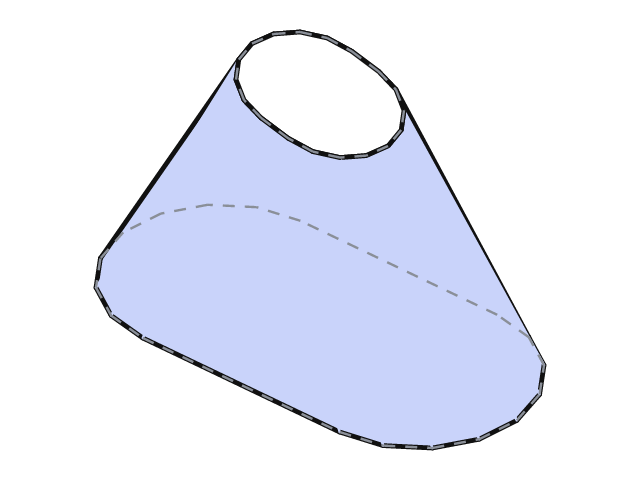
Two flat ovals joined, the top one tilted to meet a sloping face or a duct leaving at an angle, and moved off centre if needed. Height is measured to the centre of the top.
Between two ovals, the top tilted, and moved off centre if needed.
Sizes you enter
- Base length (L): Overall length of the base oval.
- Base width (W): Width of the base oval: the diameter of its half circles.
- Top length (l): Overall length of the top oval, along L.
- Top width (w): Width of the top oval: the diameter of its half circles.
- Height to top centre (H): From the base to the centre of the top.
- Top angle (α): Angle between the top and the base, seen from the front. 0 = top parallel to the base.
- Top offset along the length (X): Moves the top oval centre along L. 0 = centred.
- Top offset along the width (Y): Moves the top oval centre along W. 0 = centred.
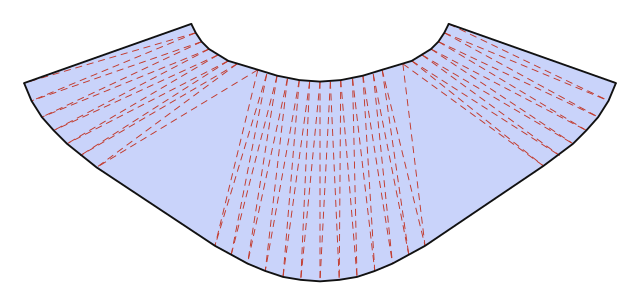
- Bend diagonals (d): A tilted top twists the corner and long-side panels; each is folded along one of its two diagonals. Both give a correct part; pick the one your press line layout needs.
What you get
The exact flat pattern of the part, worked out for the sheet thickness measured on the inside, the mean or the outside, with numbered press lines, the part in 3D, its weight and cutting length, and a DXF for laser, plasma or waterjet cutting (STEP as well).
How the pattern is developed
Development by triangulation. Surfaces that are neither cylinders nor cones (one end square, the other round; offset or skewed ends) are split into thin triangles between the two ends. The true length of every side is worked out in 3D and the triangles are laid down flat one after another, so the pattern closes exactly on the sheet. The press lines are the triangles’ long sides, numbered as on the shop drawing.
Where it is used
Transitions between two flat oval duct sizes.
Worked example
Oval to oval, Angled top at Base length 1400 mm, Base width 700 mm, Top length 500 mm, Top width 400 mm, Height to top centre 800 mm, Top angle 15°, Top offset along the length 0 mm, Top offset along the width 0 mm, Bend diagonals 1 mm, sheet thickness 0 (sizes on the mean surface), 1 part, at an end, 24 press lines:
| Base oval (mean) | 1,400 × 700 mm |
|---|---|
| Top oval (mean) | 500 × 400 mm |
| Height (H) | 800 mm |
| Top angle | 15° |
| X Offset | 0 mm |
| Y Offset | 0 mm |
| Pattern size | 2,894.54 × 1,260.18 mm |
| Area (bbox) | 3.6476 m² |
| Press lines | 51 |
| Parts | 1 |
Change any size on the page and the pattern, the press lines and these figures follow at once.
Questions
What sizes are needed to unfold a oval to oval, Angled top?
The base length (L), base width (W), top length (l), top width (w), height to top centre (H), top angle (α), top offset along the length (X), top offset along the width (Y), plus the sheet thickness and whether the sizes are measured on the inside, the mean surface or the outside. Unfoldo checks the sizes as they are typed and says which one does not make a part.
How big is the flat pattern of a oval to oval, Angled top?
It depends on the sizes. At Base length 1400 mm, Base width 700 mm, Top length 500 mm, Top width 400 mm, Height to top centre 800 mm, Top angle 15°, Top offset along the length 0 mm, Top offset along the width 0 mm, Bend diagonals 1 mm the pattern is 2,894.54 × 1,260.18 mm, in 1 part, with 51 press lines. Each pattern comes with its own size frame and area.
Where can the seams go, and can it be cut in parts?
The oval to oval, Angled top can be laid out as: 1 part, at an end; 1 part, on a flat; 2 parts, at the ends; 2 parts, on the flats; 4 parts. Several parts are drawn side by side and numbered, ready to nest.
Does it allow for the sheet thickness?
Yes. Enter the thickness and say whether each size is on the inside, the mean surface or the outside; the pattern is worked out on the mean surface, the length that does not change when the sheet is rolled or pressed.
What files does Unfoldo give for a oval to oval, Angled top?
A DXF with true arcs for laser, plasma and waterjet cutting software (the cut profile on one layer, the press lines and their numbers on others), a STEP model of the part, and a PDF shop drawing with the sizes and the true lengths of the press lines.
How accurate is it?
Arcs in the DXF are true arcs, and curves that are not arcs stay within 0.005 mm of the exact curve.
Is it free?
The pattern can be seen and tried free, without an account. The exact DXF, STEP and the tables come with Pro ($29 a month), the team plan or a 30-day pass ($19); every new account gets 15 days of Pro free, no card needed.
Other variants
More in Transitions
- Rectangle to round: Square to round and rectangle to round transitions in HVAC ductwork, fan and filter connections, hopper outlets and chimney bases.
- Rectangle to rectangle: Rectangular duct reducers, hoppers and chutes between two rectangular openings, centred, offset or cut at an angle.
- Round to round: Reducers between two round openings that are offset or not parallel, where a plain cone cannot be used.
- Oval to round: Transitions from flat oval duct to round duct or a round outlet.
- Oval to rectangle: Transitions from flat oval duct to a rectangular opening such as a grille, fan or damper.
- Ellipse to round: Transitions from an elliptical opening to round duct or pipe.
- Ellipse to ellipse: Transitions between two elliptical openings.
- Ellipse to rectangle: Transitions from an elliptical opening to a rectangular one.
- Hexagon to round: Transitions from a six-sided base to a round top, for hoppers and stacks.
- Octagon to round: Transitions from an eight-sided base to a round top, for chimney bases and silos.